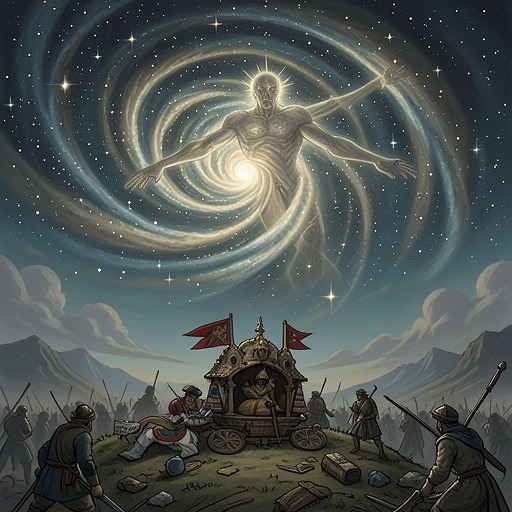
Krishna reveals the Vishvarupa
Bhagavad GitaKrishna reveals the Vishvarupa is the central revelation of the Bhagavad Gita's cosmic-form episode: in response to Arjuna's request, Krishna grants him celestial sight and displays a form that contains the entire universe, the gods, living beings, and the warriors destined to die. The vision first appears as an overwhelming disclosure of divine magnitude, then becomes a terrifying revelation of death's inevitability, and finally returns to Krishna's gentle human form so that Arjuna can recover his composure and understand action within a larger divine order.
Request and Preparation
Arjuna asks to see Krishna's sovereign form after hearing the teaching about the creation and dissolution of beings and Krishna's greatness. He acknowledges that Krishna's account has dispelled his delusion, yet intellectual understanding is not enough: Arjuna seeks direct perception of Krishna's eternal Self, provided that Krishna considers him capable of receiving it.
Krishna answers by distinguishing ordinary human sight from the vision required for the revelation. He promises to display hundreds and thousands of divine forms, diverse in color and shape, and names the Adityas, Vasus, Rudras, Ashvins, and Maruts among the marvels Arjuna will behold. Because Arjuna cannot see the sovereign form with his ordinary eyes, Krishna gives him celestial sight. The revelation is therefore not simply a spectacular change in appearance; it is an altered mode of perception made possible by divine power.
The Universal Body
Sanjaya narrates that Krishna then reveals his supreme sovereign form. It has many mouths and eyes, innumerable aspects, celestial ornaments, uplifted weapons, garlands, robes, and fragrances. The form is infinite, radiant, and turned in every direction. Its brilliance is compared to the simultaneous bursting forth of a thousand suns, while its body gathers the entire universe, divided and subdivided into countless parts, into one visible totality.
Arjuna sees the gods, Brahma seated on the lotus, the Rishis, celestial serpents, and hosts of creatures within Krishna's body. He also sees innumerable arms, stomachs, mouths, and eyes, with no discoverable beginning, middle, or end. Krishna bears a diadem, mace, and discus; the Sun and Moon serve as his eyes, and blazing fire is his mouth. Heaven, earth, and every direction are pervaded by him. The form is therefore not an enlarged human figure but a totalizing body in which creation, divinity, space, and power become visible at once.
The sight produces both recognition and disorientation. Arjuna identifies Krishna as the indestructible Supreme object, the guardian of eternal virtue, the ancient Being, and the immeasurable source pervading the universe. At the same time, the triple world trembles, the gods enter the form, and Rishis and Siddhas praise it while other hosts look on in amazement. The revelation joins worshipful splendor to an unsettling collapse of ordinary boundaries: Krishna is at once the being who contains the cosmos and the force before which the cosmos loses its separateness.
The Vision of Destruction
The form's most violent aspect emerges when Arjuna sees the sons of Dhritarashtra, the kings, Bhishma, Drona, Karna, and the principal warriors of both sides entering Krishna's terrible mouths. Some strike against the spaces between his teeth with their heads crushed. Arjuna compares the warriors to rivers rushing through different channels toward the ocean and to moths accelerating into a blazing fire. The images make their deaths appear not as a contingent result awaiting the battle but as a movement already carried within the structure of the vision.
Krishna's flaming mouths swallow the men from every side, and his energy fills and heats the universe. When Arjuna asks who possesses such a fierce form and what its action means, Krishna gives the revelation its clearest doctrinal name: he is Death, the destroyer of worlds, fully developed, engaged in slaying the race of men. The warriors in the opposing divisions will perish even without Arjuna. Krishna therefore commands Arjuna to rise, gain glory, vanquish the foe, and become his instrument. Drona, Bhishma, Jayadratha, Karna, and other heroic warriors are described as already slain by Krishna; Arjuna's task is to fight rather than to imagine that the final outcome depends on his independent power.
This declaration changes the moral shape of the battlefield. Arjuna's earlier grief arose from seeing teachers, elders, friends, and kinsmen and fearing the destruction of family customs and social order. The cosmic vision does not erase the horror of killing; it places that horror inside a divine process in which death has already been disclosed as the governing power. Human agency remains necessary, but it is redefined as participation in an outcome whose ultimate cause lies beyond the warrior's individual will.
Fear, Apology, and Restoration
Arjuna responds with trembling, joined hands, and a voice choked by fear. He praises Krishna as the Supreme Soul, the first and ancient Being, the refuge and knower of the universe, and recognizes him through an immense chain of divine identities, including Vayu, Yama, Agni, Varuna, the Moon, Prajapati, and the Grandsire. Yet devotion is accompanied by an admission of personal error. Arjuna recalls having treated Krishna as a friend and addressed him as Krishna, Yadava, or friend without understanding his greatness. He asks forgiveness for the familiarity and disrespect shown during play, meals, rest, and private or public occasions.
The request for forgiveness marks a reversal in their relationship. Krishna had been Arjuna's companion and trusted interlocutor; the revelation discloses him as the father of the universe and the supreme master, leaving no equal or superior in the three worlds. Arjuna's former intimacy is not denied, but it is reinterpreted as an incomplete perception of the same being. He asks Krishna to show the diademed, mace-bearing, discus-holding form seen before, because the universal form has left his mind troubled and deprived him of peace.
Krishna responds graciously. He explains that the supreme universal form was shown through his mystic power and had been seen by no one in the human world except Arjuna, not even through study of the Vedas, sacrifices, gifts, actions, or the severest austerities. He tells Arjuna to let go of fear and perplexity and promises that the ordinary form will be shown again. Krishna then resumes his own gentle form and comforts the afflicted warrior. Arjuna says that, seeing this human form, he has recovered his right mind and returned to his normal state.
Significance for Action and Devotion
The revelation makes vision itself part of the teaching. Arjuna's first crisis is ethical and familial, but the cosmic form supplies a perspective in which the individual warrior, the opposing armies, and the destruction of the world are held within a larger divine reality. Krishna's command to act does not rest only on social duty or the promise of victory; it follows from the recognition that Krishna is both the universal ground and the death that consumes the combatants.
The episode also establishes the exceptional character of direct access to Krishna. The universal form cannot be reached merely through learning, austerity, gifts, sacrifices, or prescribed actions. Krishna later states that exclusive reverence makes it possible to know, see, and attain him truly. The vision therefore joins revelation to devotion: celestial sight is granted by divine favor, while the proper human response is surrender of attachment, freedom from enmity, and action directed toward Krishna.
Its final movement restores a necessary scale. The infinite form is indispensable because it breaks Arjuna's limited understanding, but it is not the form in which he can remain psychologically composed. Krishna's return to the gentle human form turns terror into renewed capacity for action. The revelation thus functions as a complete transformation: Arjuna moves from confusion, through astonished recognition and cosmic dread, to restored steadiness under a command whose authority he now understands as divine rather than merely personal.